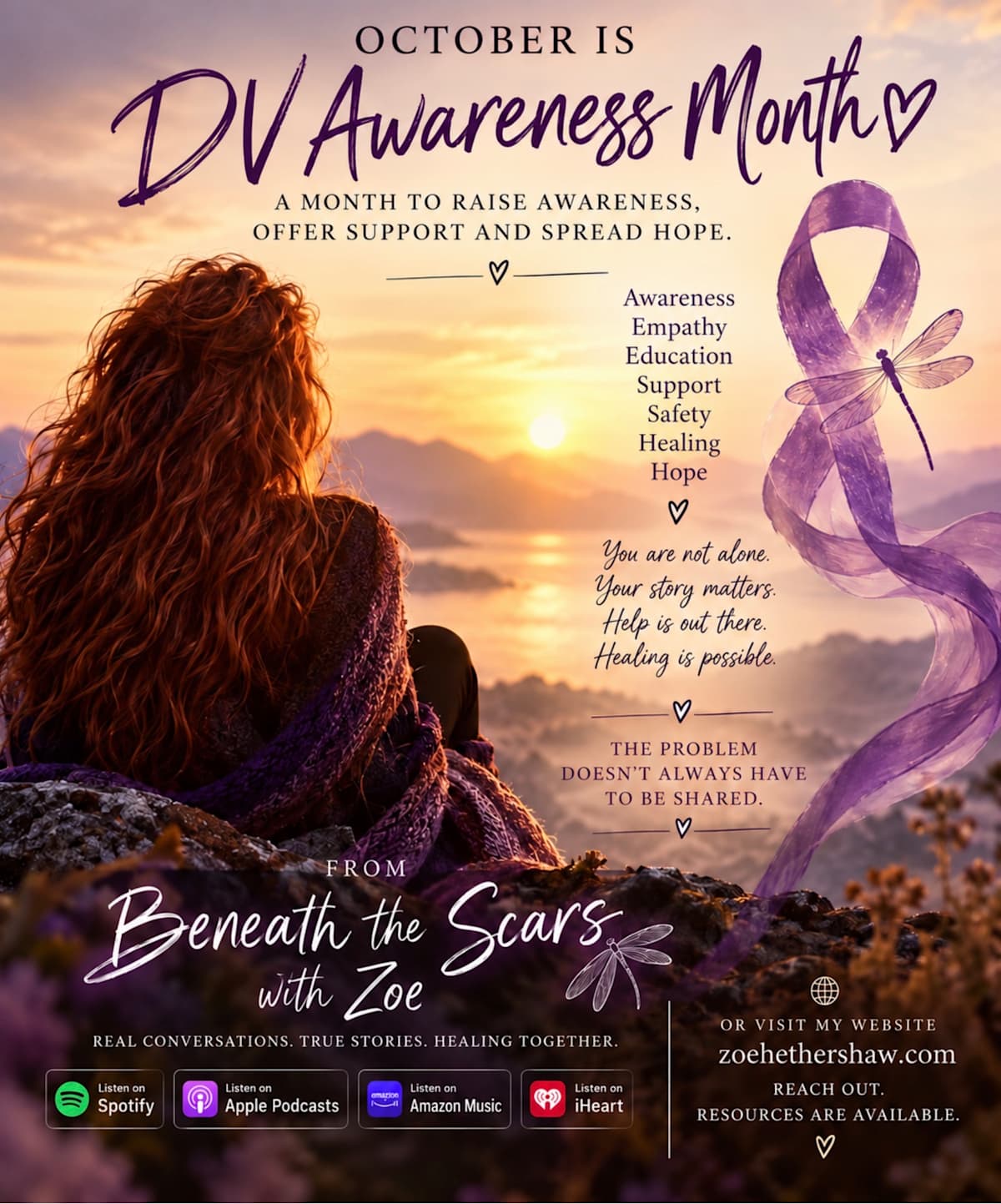
October DV Awareness Month: Hope Is Not Lost
By Zoe Hethershaw | Beneath the Scars with Zoe
October is DV Awareness Month, and this month, I want to talk about something that can sometimes feel impossible to hold on to when life has knocked you to your knees.
Hope.
Not the pretty, polished kind of hope that tells you everything happens for a reason. Not the kind that expects you to smile through the pain, put on a brave face, and pretend everything is perfectly fine when, behind closed doors, your world is falling apart.
I mean the quiet kind of hope.
The kind that whispers, perhaps tomorrow will be different.
The kind that helps you get out of bed when you have spent the night questioning your worth. The kind that reminds you that you are still a person, with a voice, a heart, dreams, and a future, even when you have spent so long feeling as though you have lost yourself.
And I say this not just as a woman who talks about healing, but as a woman who has had to find her own way through it.
I’ve lived through things that took me a long time to understand, let alone heal from. I’ve experienced emotional abuse, and I’ve learned that the damage doesn’t always end when the relationship does. Sometimes, the hardest part comes afterwards, when you are left picking through the pieces of yourself, trying to work out what happened, what you believe, and how on earth you ended up questioning your own worth.
One of the hardest things for me to overcome was blaming myself.
It took me a long time to stop doing that.
When you’ve spent so long in a relationship where everything seems to be your fault, you can eventually start believing it yourself. You begin to question your reactions, your words, your feelings, and even your memories. You replay conversations in your head, wondering what you could have said differently or whether you could have prevented the next argument.
You start walking on eggshells because you never quite know what version of the day you are going to get.
Perhaps they have had a bad day at work, and somehow it becomes your fault. Perhaps something hasn’t gone their way, and you find yourself carrying the blame. Perhaps they are angry, frustrated, unhappy or disappointed, and before you know it, you are apologising for something you didn’t do.
You begin to feel responsible for everybody else’s emotions.
You become the peacekeeper, the fixer, the one trying to make everything right. You think that if you can just be a little more understanding, a little more patient, a little quieter, a little less demanding, perhaps things will finally settle down.
And when they don’t, you blame yourself again.
I know what it is like to look back and wonder why I didn’t see things sooner, why I stayed as long as I did, or why it took so much out of me to find my way back to myself.
But healing has taught me something important.
Someone else’s behaviour is not a reflection of your worth, and you are not responsible for managing another adult’s emotions.
You can have a bad day without making someone else pay for it. You can be angry without humiliating somebody. You can disagree without frightening somebody. You can be unhappy without making the person beside you believe that their existence is the problem.
That is the difference between having difficult moments in a relationship and living in a pattern where you are made to feel responsible for someone else’s behaviour.
And when you’ve lived with that for long enough, it can take time to untangle the two.
Sometimes, even after you have left, the blame follows you. It sits in the back of your mind and whispers that perhaps you were the problem after all. You may find yourself apologising when you haven’t done anything wrong, explaining yourself when you don’t need to, or feeling guilty simply for putting your own needs first.
You might have physically walked away, but emotionally, you are still trying to prove that you deserved better.
That was something I had to learn for myself.
Leaving a relationship doesn’t automatically mean you leave every lesson you were taught inside it. Sometimes, you carry those lessons into the next chapter without even realising it. You become so accustomed to surviving that peace can feel unfamiliar, and you can spend a long time trying to understand why you still feel the need to defend yourself when nobody is attacking you.
That is why I believe healing is about more than simply moving on.
It is about finding your voice after silence. Finding your strength after fear. Finding your peace after chaos.
It is about learning that you can say no without writing an essay to explain yourself. That you can have boundaries without being cruel. That you can disappoint someone without being a bad person. That you can walk away from something that is hurting you without having to convince everybody else that your reasons are good enough.
And perhaps one of the biggest lessons of all is learning to stop apologising for things that were never yours to carry.
For me, this journey has been about survival, healing, and self-discovery. It has been about recognising the parts of myself that became buried beneath years of trying to keep the peace, keep things together, and make sense of experiences that left their mark on me.
It has meant looking at the past honestly, without allowing it to dictate my future.
It has meant accepting that I cannot change what happened, but I can change the way I see myself because of it.
And it has meant learning that I don’t have to spend the rest of my life paying for someone else’s choices.
I am not sharing this because I have every answer. I am sharing it because I know how lonely it can feel when you think you are the only person who doesn’t understand how you got here.
I know what it is like to question yourself.
I know what it is like to carry blame that doesn’t belong to you.
And I know that finding yourself again can take much longer than anyone on the outside might realise.
But I also know that the journey doesn’t have to end there.
Domestic violence is not always visible. Sometimes, there are no bruises to explain away, no broken bones, and no obvious signs that anything is wrong. Sometimes, the wounds are emotional, psychological, financial, sexual, or hidden behind a smile that has become second nature.
Sometimes, the person who hurts you is also the person who tells you they love you.
And that can make finding your way through the confusion incredibly difficult.
You might question yourself. You might wonder whether you are overreacting. You might make excuses for their behaviour because you remember the good days, the apologies, and the promises that things will change. You might even begin to believe the things they have said about you.
But I want you to hear something.
You are not responsible for someone else’s decision to hurt you.
You do not have to earn kindness. You do not have to prove that you deserve respect. You do not have to become smaller, quieter, more accommodating, or less yourself to keep somebody else happy.
Love should not require you to disappear.
And if you have reached a point where you barely recognise the person staring back at you in the mirror, please know that the person you were before all the hurt has not necessarily disappeared. You may simply have spent so long surviving that you have forgotten what it feels like to live.
Healing is not a race. It is not a straight line, and it certainly does not follow somebody else’s timetable.
Sometimes, healing begins with saying the truth out loud for the first time. Sometimes, it begins with speaking to someone you trust. Sometimes, it begins with quietly gathering information, making a plan, or allowing yourself to imagine a life that feels safe.
And sometimes, the bravest thing you can do today is simply acknowledge that something is not right.
You do not have to share your story publicly to make it real. You do not owe anybody the details of what happened to you. You do not need to justify your decisions to people who have never had to live your life.
The problem doesn’t always have to be shared for your pain to be valid.
There is no shame in needing help. There is no weakness in being frightened. And there is no failure in taking your time to work out your next step.
For some people, leaving is not immediately possible. There may be children to consider, financial barriers, threats, isolation, or fears about what might happen next. Every situation is different, and safety must come first. If you are living with abuse, you deserve support that respects your circumstances and helps you consider your options without judgement.
At Beneath the Scars with Zoe, I believe in real conversations, true stories, and the possibility of healing. I believe we need to talk about the things people are often afraid to say out loud. Not to sensationalise pain, but to bring understanding into places where shame and silence have lived for far too long.
Because awareness matters.
Empathy matters.
Education matters.
Support matters.
And hope matters.
If you are reading this and recognising pieces of your own life, please don’t feel that you have to figure everything out today. Take one step at a time. Reach out to somebody safe when you can. Seek professional support if it is available to you, and remember that you deserve to be treated with dignity, whether you are ready to leave, have already left, or are still trying to understand what has happened.
If you are in immediate danger, contact emergency services when it is safe to do so.
And if you are reading this because someone you love may be experiencing abuse, listen without judgement. Believe them. Avoid telling them what they must do. Sometimes, being the person who offers steady, compassionate support can make a world of difference.
We cannot always see what another person is carrying. We cannot always know what happens when the front door closes. But we can choose to be kinder, more informed, and more willing to listen.
This October, let us make room for the conversations that matter. Let us challenge the belief that abuse is a private matter that nobody should discuss. Let us remind people that support exists, that their experiences deserve to be taken seriously, and that their lives are worth protecting.
And above all, let us remember that a person’s story does not end with what happened to them.
There can be life after survival. There can be laughter after grief. There can be trust after betrayal, confidence after years of criticism, and peace after a long season of fear.
It may take time. It may take support. It may involve rebuilding parts of yourself you thought were lost forever.
But your past does not have to define every chapter that follows.
If you have survived something that once made you believe you would never be whole again, I hope you give yourself credit for still being here.
If you are still in the middle of it, I hope you know that you matter right now, not just in some imagined future when everything is better.
And if you are beginning again, even in the smallest way, I hope you allow yourself to believe that something good can still grow.
You do not have to blame yourself forever for what someone else chose to do.
You do not have to keep carrying guilt that was placed on your shoulders.
And you do not have to spend the rest of your life trying to prove that you were worthy of being treated well.
You always were.
You are not alone. Your story matters. Help is out there. Healing is possible.
This is Zoe Hethershaw, from Beneath the Scars with Zoe, reminding you that you are more than the things you have survived.
Sometimes, hope doesn’t arrive as a great revelation. Sometimes, it arrives when you finally begin to understand that what happened to you was not all your fault.
Sometimes, it arrives when you stop asking, “What was wrong with me?” and begin asking, “What do I need to heal?”
And sometimes, hope begins when you give yourself permission to put down the blame, take back your voice, and find your way home to yourself.
Because you deserve a life that is about more than surviving.
You deserve to live.
With love, compassion, and hope,
Zoe Hethershaw
Beneath the Scars with Zoe
Listen to the podcast on Spotify, Apple Podcasts, Amazon Music, and iHeart, or visit zoehethershaw.com to connect and explore more of my work.
If you need support, you can visit ShelterSafe.ca to find shelters and support resources across Canada. If it is unsafe to browse on your device, consider using a safer device when seeking help.